|
|
Contact Us
|
||||||
|
|
|
|||||||
|
|
1967 |
SHELBY RESEARCH GROUP | ||||||
|
|
|
|
||||||
|
|
|
|
|
|
|
Contact Us
|
||||||
|
|
|
|||||||
|
|
1967 |
SHELBY RESEARCH GROUP | ||||||
|
|
|
|
||||||
|
|
|
|
|
|
California Emissions
The California Air
Resources Board (CARB) was established in 1967, combining the
Bureau of Air Sanitation and the Motor Vehicle Pollution Control
Board. Their regulations applied to all new '67 model-year
vehicles with large displacement ('big block') engines,
including the Ford FE 390-4V Mustang and the Shelby GT 500 with
428-8V Special Interceptor. The First GT 500 Thermactor Car(s) As the '67 Shelby program kicked off, Shelby American started placing Domestic Special Orders (DSOs) with Ford in early August 1966. When the SRG reviewed the DSOs on microfiche, we found the first eight (8) GT 500 units ordered with emissions were almost reassigned to be built in Metuchen rather than San Jose. For some time, we wondered why. It was Randy Gillis (RiP) who proffered that the California emissions system on the 428-8V S.I. had not yet been tested and certified yet by the California CARB. Why redirect their assembly to Metuchen? We speculate that there was a loophole that allowed manufacturers to build cars outside of California and then ship them to California for purposes other than new retail sales. In an abundance of caution, it appears that FoMoCo was prepared to do this. However, five (5) of the eight (8) cars were delayed and then canceled due to a different issue (cooling problems of GT 500 air-conditioned cars).
Rather than build them
outside of California,
a different solution
(loophole) was found. Build the cars inn California, and
designate them as 'Engineering' units. This allowed the first
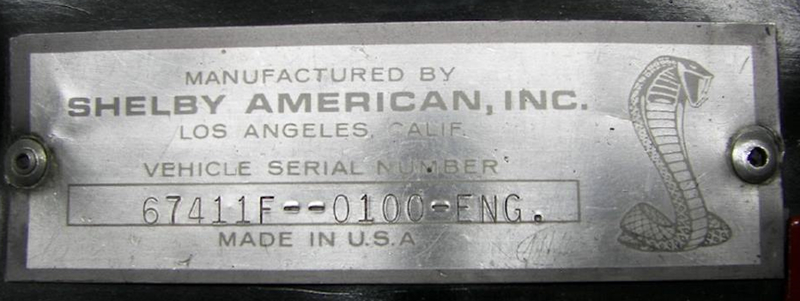
three (3) GT 500 Thermactor cars, #0100, #0131, and #0139 to get
built in California and remain in California. This explains why
their VIN plates have an added "ENG" (Engineering) stamp.
67411F--0100-ENG.
(Car #0100) The first regular production GT 500, was ordered
with Thermactor, however, it does not appear that this car
received an emissions engine at Ford's San Jose assembly plant.
The DSO requested emissions, and a Ford Change Notice deleted
it. However, the Ford 'as-built' computer record indicates the
car did get the Thermactor engine (likely just not updated for
the last-minute change). The 411F package code in the Shelby VIN
indicates no emissions, and in-period photographs of the engine
bay do not show any emissions components. #0100 was
expeditiously built 18 days ahead of schedule at San Jose to get
it to Shelby American and then into the magazine editors' hands
so that the media opportunity window was not missed. That
expedition was likely made possible by omitting the
not-yet-CA-certified emissions system on the 428-8V Special
Interceptor. As outlined above, being manufactured in California
with an uncertified (or non-existent) emissions system is likely
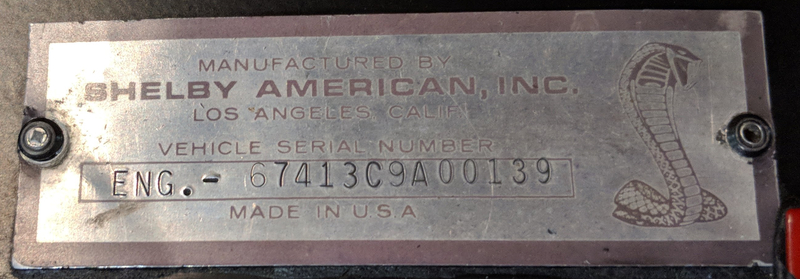
the reason behind the -Eng[ineering] stamp added to the
Shelby VIN plate. ENG.-67413C9A00139 (Car #0131),the third regular production GT 500; and the only '67 GT convertible. Built by San Jose about two weeks after the other two cars. #0139 was ordered with emissions and, according to the Ford as-built computer record, was built with emissions. The 413C package code in the Shelby VIN indicates the car had the Thermactor system. It is likely that #0139 was the first GT 500 unit to receive an uncertified emissions system. Regardless, because the 428-8V SI emissions system had still not been tested/certified by the state of California, #0139 also received the ENG[ineering] designation stamped into the Shelby VIN plate.
Based on Ford computer record analysis, the SRG's theory is that regular production of the GT 500 Thermactor-equipped was supposed to begin in late December 1966. It was realized that the 428-8V Thermactor engines (402F and 412F packages) were not going to be ready and/or certified in time, so the scheduled assembly of these units was pushed out into early January 1967.
Apparently that still was not
enough time, but it was now too late to reschedule the units, as
the chassis assembly had already started. The first 33x GT 500
cars that were supposed to received the Thermactor engines did
not; non-Thermactor engines were substituted so the assembly
line would not come to a halt. Just a couple of days later, once
the certified engines arrived at their station on the line, a
'make-good' operation substituted 33x 428-8V Thermactor engines
into GT 500s that were ordered without it. Notes GT 350 (289-4V HiPo) units with Thermactor (EECS) were built by Ford's San Jose plant beginning on May 15, 1967. We trust this launch date was in compliance with California regulations. Not all Thermactor-equipped GT 350 and GT 500 cars were sold within the state of California. In cases where a vehicle was sold outside of California, a credit was typically issued to the dealer for the wholesale price of the Thermactor emissions system.
As this topic's
data demonstrates, some non-Thermactor GT 350 and
GT 500 units were 'mistakenly' sold in the state of California..' See Also |
|
©2018–2026 The Shelby Research Group ▪ Where Knowledge is Freely Shared™ ▪ Disclaimer, Fair Use Notice, Contact Us |