|
|
Contact Us
|
||||||
|
|
|
|||||||
|
|
1967 |
SHELBY RESEARCH GROUP | ||||||
|
|
|
|
||||||
|
|
|
|
|
|
|
Contact Us
|
||||||
|
|
|
|||||||
|
|
1967 |
SHELBY RESEARCH GROUP | ||||||
|
|
|
|
||||||
|
|
|
|
|
|
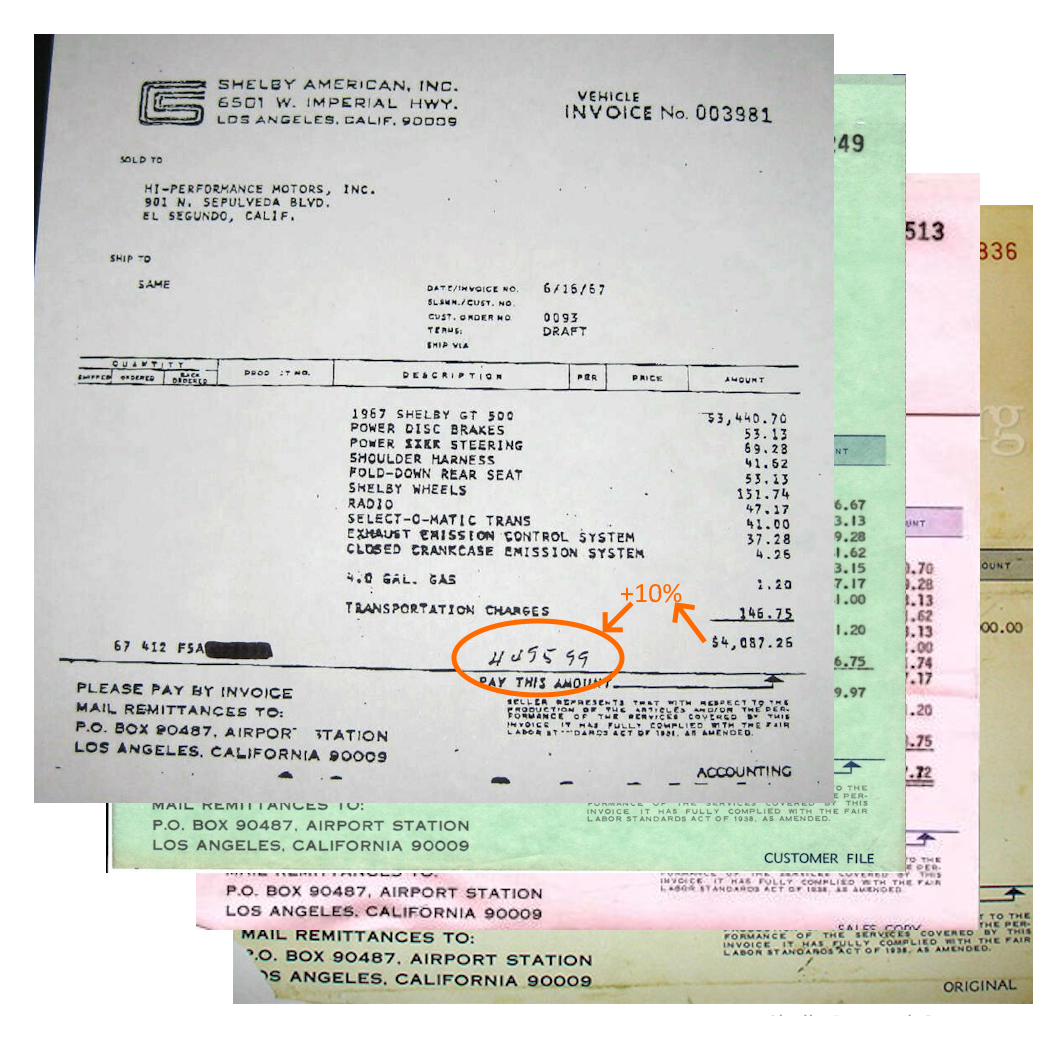
Types of Invoices Vehicle 'Vehicle Invoices' were used for cars throughout the California-nased Shelby program. With the exception of some exported units, each car had its own invoice. The layout of the Vehicle invoices changed in April 1966, from a full-size portrait page to a smaller page that was landscape-oriented. These were NCR carbonless forms. We've identified at least four (4) pages, named: Original, Sales Copy, Accounting, Customer File.
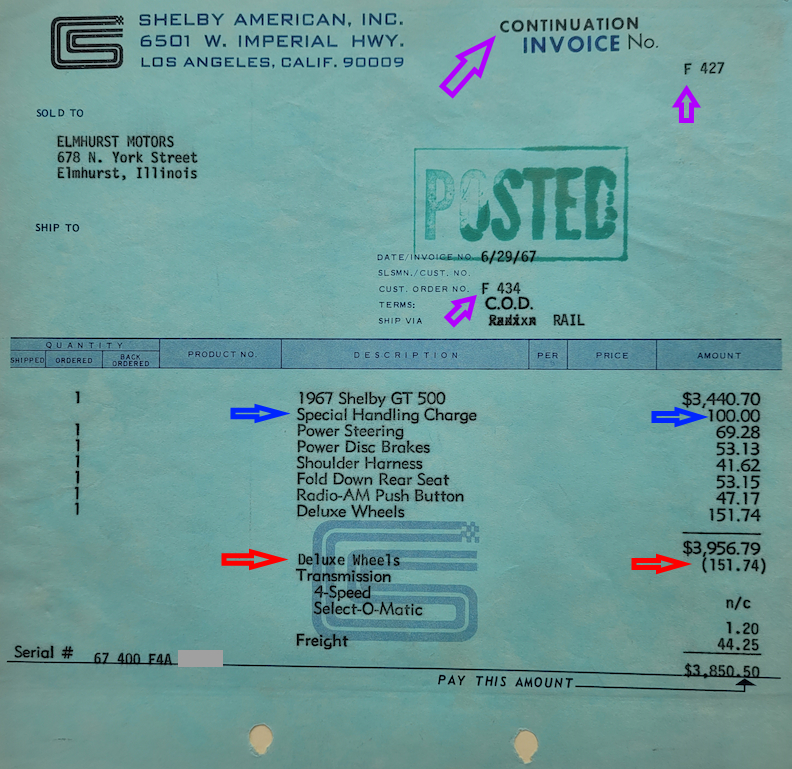
Continuation 'Continuation Invoices' were introduced in April 1967 for cars that were sold through FoMoCo to non-Shelby-Franchised dealers. The earliest Continuation Invoices that we've found belong to the 37 Sales District demonstrator cars. Allowing NSF delears to sell Shelby GTs All Continuation Invoice numbers carry an "F" prefix, which we assume stands for "Ford." Ford Order Numbers also share the same "F" prefix.
From the information gathered from Continuation Invoices so
far, most units sold to NSF Ford dealers were outfitted with
deluxe (Shelby 10-spoke or KH Mag Star) wheels. We expect to
find most cars to have been equipped with an AM radio as well.
Because the Continuation Invoices were pre-printed, on the rare
occasions when the car wasn't fitted with deluxe wheels and/or
an AM radio, a deduction (or 'deletion') was added by
typewriter. Generic Non-automobile Invoices were also used. Invocies for parts carried a 'P' prefix. A Parts Invoice was used to bill FoMoCo for defective drive train components on new cars.
Invoice Errors Through the collection and auditing
of Shelby American invoices (shared with the SRG by car owners),
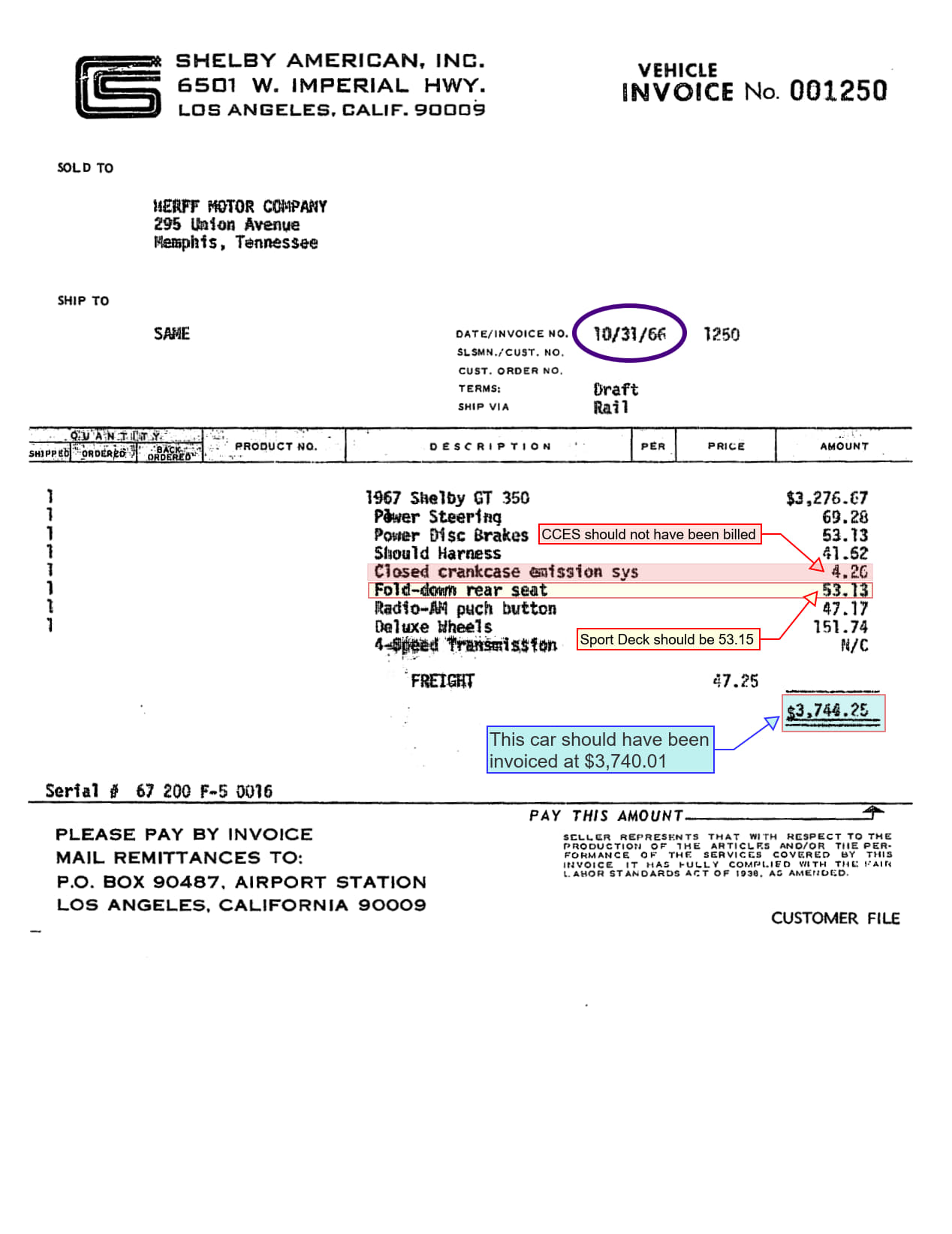
we've identified several different errors: REAR SEAT - Line item pricing error with the fold-down rear seat. The occasional mistake accidentally priced the Fold-down rear seat line item at $53.13 ($0.02 less than the $53.15 it should have been). This mistake appears to be a 'human error' and has only been found on some of the hand-typed 'Vehicle' type invoices. 'Continuation' type invoices were pre-printed and were therefore immune to such a mistake. CLOSED CRANKCASE EMISSIONS SYSTEM (CCES) - On the earliest invoices, specifically those dated in October 1966, we discovered a line item that mistakenly billed dealers $4.26 for the CCES. The cars equipped with a Thermactor system (a/k/a/ California Emissions) would have both a CCES line item and a second line item for the Exhaust Emissions Control System (EECS). Only GT 350 cars had been completed and invoiced in October 1966; no GT 500 Thermactor cars had been completed/invoiced yet. The first Thermactor-equipped GT 350 cars were not built by Ford's San Jose assembly plant until May 15, 1967. These queries assume all cars invoiced in October 1966 will contain this mistake. Without the ability to audit the paperwork, we've noted additional cars on in purple as 'Likely". We've also discovered that the CCES line item was mistakenly omitted from invoices on the earliest GT 500 Thermactor cars sold. Invoices for Thermactor cars should have two line items on their invoice: one for the $4.26 CCES and one for $37.28 EECS. The invoices associated with these cars are missing the $4.26 CCES line item. This mistake appears to have been remedied on the last day of February 1967. A $1.20 line item for 4.0 gallons of gas appears to have been implemented on March 23, 1967. Invoices before this date did not have the gas line item. Cars invoiced on or after this date should have the gas line item, but occasionally, it was missed. Invoices have been found with multiple errors:
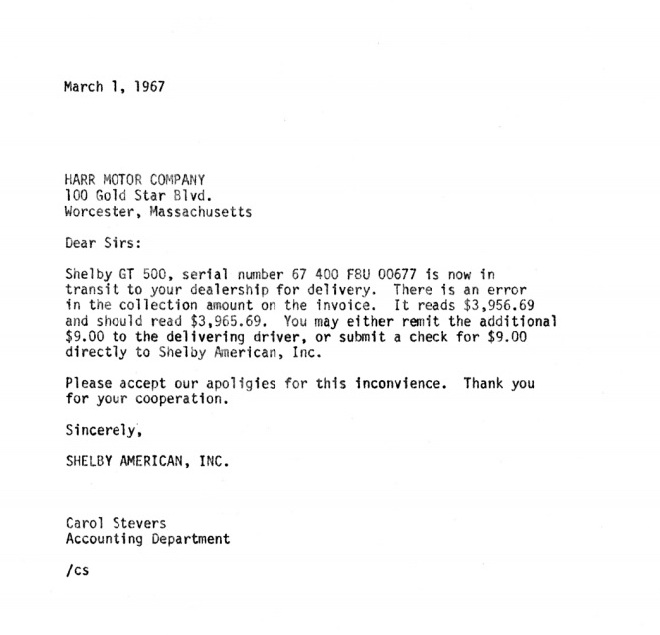
Sometimes, invoice errors were discovered and corrective actions were taken:
Reviewing The Data Invoiced column cells shaded in light yellow signify a date that is more than 90 days after the Production Order's completion date. Cells shaded in blue signify an anomaly, such as (a) the car's completion date being after the car's invoice date, and/or (b) the car's shipped date being before the car's invoice date.
Ongoing Research We primarily collect invoices to gather Freight Charge, and
customer numbers (found only on invoices dated in calendar-year
1966), and to identify errors such as those mentioned above. See Also |
|
©2018–2026 The Shelby Research Group ▪ Where Knowledge is Freely Shared™ ▪ Disclaimer, Fair Use Notice, Contact Us |